
Are You Hearing More About
Hyperbaric Oxygen?
Breathe oxygen at a concentration greater than 90% inside a pressurized chamber and your blood carries far more of it — into brain and body tissue where ordinary circulation struggles to reach.
Oxygen that reaches what blood flow can't.
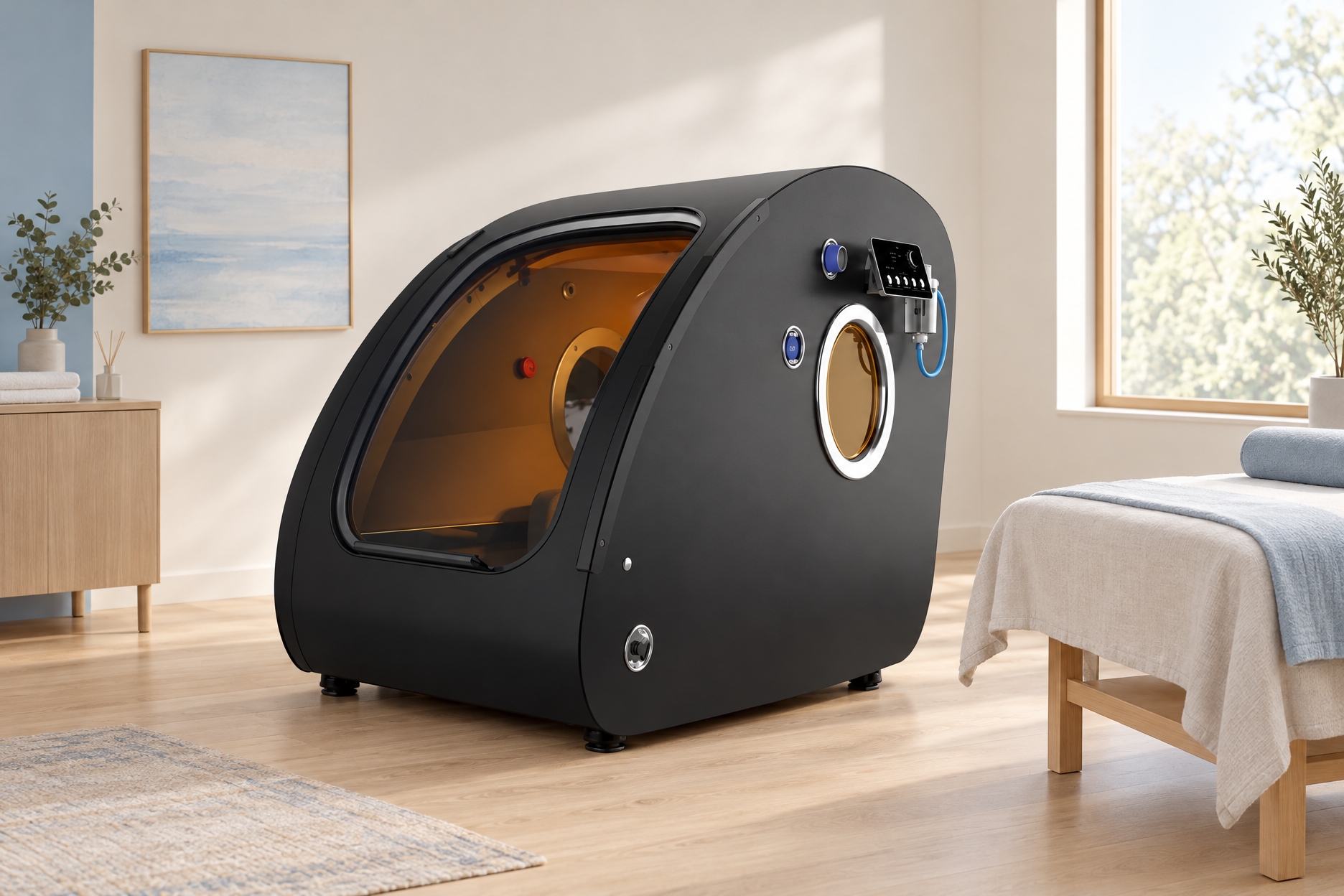
Hyperbaric oxygen therapy (HBOT) places you in a chamber where the air pressure rises to roughly twice what you feel at sea level. Under that pressure, breathing oxygen-rich air dissolves far more oxygen directly into your blood plasma — the fluid part — rather than relying only on red blood cells to carry it. That dissolved oxygen reaches tissue that narrowed or damaged vessels cannot supply well — the brain, injured muscle and tendon, and tissue healing after surgery. Surgery is, physiologically, a controlled soft tissue injury, and that is exactly the kind of healing HBOT has been shown to support.
Why pressure changes everything
At normal pressure, almost all the oxygen in your blood is bound to hemoglobin inside red cells, and those cells are already close to full. Raising the pressure is the only way to add oxygen on top of that ceiling — it forces extra oxygen to dissolve into plasma, which then perfuses tissue that red cells can't reach because the vessels there are too narrowed or too damaged.
What repeated sessions do
A single session is a dose of oxygen. A course of sessions is a signal. Repeated cycles of high oxygen followed by normal oxygen appear to trigger the body's own repair programs — new blood vessel growth, mobilization of stem cells from bone marrow, and a reduction in chronically inflamed, senescent tissue. Researchers call this the hyperoxic-hypoxic paradox: the body responds to the swing, not just the oxygen.
Surgery is controlled trauma — and it heals like it
A knee replacement, a rotator cuff repair, an ACL reconstruction: each is a controlled soft tissue injury. Swelling, oxygen delivery and early movement decide how that tissue recovers, which is why post-operative recovery is one of the strongest uses of HBOT. Reducing muscle damage and inflammation in the first few days is what lets rehabilitation start sooner and progress faster.
Shown to help. Here is how much.
Read this section the way a clinician would: not "does it work", but "for which use, and how strong is the evidence".
Global cognitive function
HBOT has been shown to improve global cognitive function — not one narrow test score, but the overall picture: attention, processing speed, recall and clarity of thought. The same approach is being used with reported benefit in Alzheimer's disease, Parkinson's disease and dementia.
Sleep quality
Across conditions, HBOT has been associated with better sleep quality, with the largest improvements in people whose sleep was worst to begin with. In a randomized trial, self-reported sleep scores improved versus sham treatment.
Recovery from surgery and injury
Surgery and injury are the same biological event at different scales: tissue has been disrupted and has to be rebuilt. HBOT has been shown to improve recovery from orthopedic surgery — less muscle damage and inflammation in the early days, better early range of motion — and to speed graft healing after ACL reconstruction and recovery from muscle injury.
Markers of biological aging
In a prospective trial, 60 daily sessions lengthened telomeres in immune cells by more than 20% and reduced senescent ('aging') cells by 10–37%. This is early, small-scale evidence — promising, not settled.
Moderate to strong, depending on the use. The full reference list — with every study openable on PubMed — is on the evidence page.
What a treatment actually looks like.
Pressurize
You relax in the chamber while pressure rises to roughly twice sea level — like a calm descent in a dive, without getting wet.
Dissolve
You breathe oxygen at a concentration greater than 90%. Under pressure, far more of it dissolves into plasma and reaches tissue that limited blood flow struggles to supply.
Repair
Repeated sessions stimulate new vessel growth and stem-cell activity, rebuilding supply to stressed tissue over weeks, not minutes.
This is probably not for everyone.
It tends to fit people who:
- You are sharp but slower than you used to be, and you want to know whether that is measurable and changeable.
- You sleep poorly and have already tried the obvious fixes.
- You are recovering from surgery or a soft-tissue injury and want to support the healing phase.
- You train hard and recover slowly.
- You are managing a wound or a condition your physician has already flagged as an HBOT indication.
If none of that is you, the measurement will tell us — and we will point you somewhere better.
HBOT is a physician-supervised treatment, not a spa service. The most common side effects are temporary pressure discomfort in the ears and mild fatigue. Serious risks are rare and largely preventable with screening. An untreated collapsed lung (pneumothorax) is an absolute contraindication. Certain chemotherapy agents and some heart conditions require individual review. Your OrthoVida clinician determines whether HBOT is appropriate for you before your first session.
What people ask us.
Is it claustrophobic?
Our chambers are large enough to sit upright and read or watch a screen, and you are never locked in — a clinician is present and the chamber can be depressurized at any time. If you are anxious in enclosed spaces, tell us in advance and we will walk you through it first.
How many sessions does it take?
Single sessions are a dose; change usually comes from a course. Research protocols range from 40 to 60 sessions. Your plan is set after your evaluation, and we will tell you honestly what a realistic course looks like for your goal.
Can I drive home after?
Yes. Most people feel normal or mildly tired afterwards. Some feel a temporary change in vision for a few minutes after a session; we ask that you wait in the office until it clears.
Is this the same as hospital hyperbaric oxygen?
No. We run a 2 ATM recovery and performance protocol — 60 to 90 minutes, 20 to 40 sessions — aimed at cognition, sleep, post-surgical and athletic recovery and energy. The 3 ATM hospital protocols exist for wound salvage, diabetic foot ulcers and radiation injury; those belong in a hospital hyperbaric service, and we refer them out.
Is this the same as the oxygen bar at a spa?
No. A spa oxygen bar delivers normal-pressure, low-concentration oxygen through a cannula — it does not meaningfully change the oxygen content of your blood. HBOT requires a pressurized chamber and medical-grade oxygen at pressure.
Other lines in the program.
Curious what HBOT could do for you?
The answer starts with your numbers, not with the treatment. Book an evaluation.