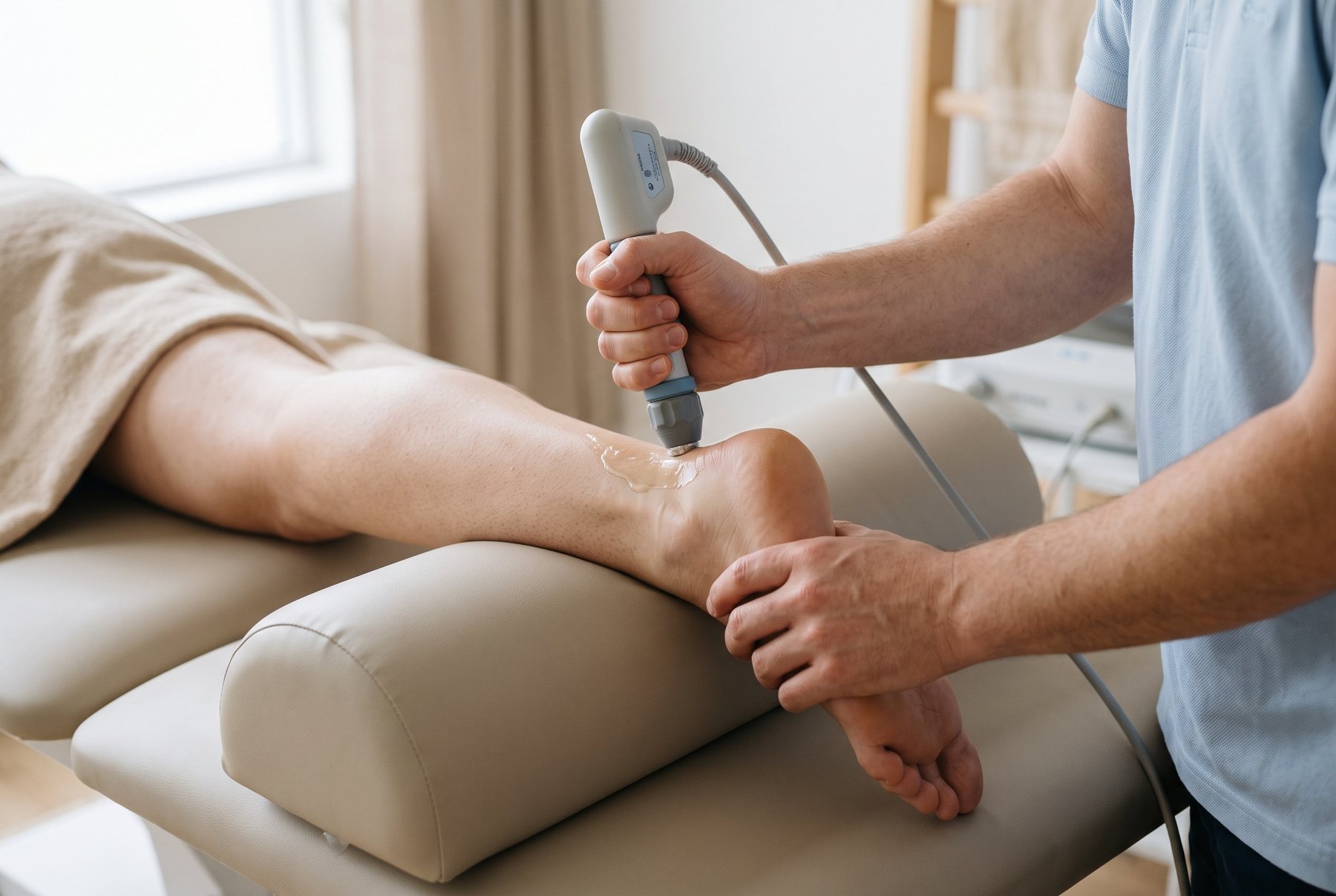
For the tendon that stopped healing.
Extracorporeal shockwave therapy (ESWT) delivers high-energy acoustic pulses into tissue through the skin. Unlike ultrasound, the pulses are brief and high-amplitude — they create mechanical stress at the boundary between tissues. In a tendon that has been chronically inflamed and poorly healing for months, that stress appears to disrupt the stuck repair cycle, stimulate blood flow, and prompt the body to lay down new, better-organized tissue.
What the pulses do
Shockwaves create micro-mechanical forces at tissue interfaces. In chronic tendinopathy, the result is a controlled, localized response: increased local blood flow, breakdown of calcific deposits, release of growth factors, and a shift from a degenerative state back toward healing. It is not painless — the treatment itself is uncomfortable — but there are no needles and no downtime.
Focused versus radial
Radial devices spread energy over a wider, shallower area. Focused devices concentrate energy at a specific depth and are the type used in most of the high-quality trials for plantar fasciitis and calcific tendinitis. We use focused delivery where depth and precision matter.
Where the evidence is strongest
Plantar fasciitis and calcific tendinitis of the shoulder have the most consistent randomized evidence, with several meta-analyzes showing meaningful pain reduction and functional improvement versus control. Patellar and Achilles tendinopathy also show benefit in recent systematic reviews, though the evidence is more variable.
Shown to help. Here is how much.
Read this section the way a clinician would: not "does it work", but "for which use, and how strong is the evidence".
Plantar fasciitis
Meta-analyzes of randomized controlled trials show shockwave therapy is effective for chronic plantar fasciitis, with meaningful reductions in heel pain and improved function.
Calcific tendinitis of the shoulder
One of the best-supported indications: shockwave therapy reduces pain and improves function, and in a substantial proportion of patients the calcium deposit resorbs.
Patellar and Achilles tendinopathy
A 2023 systematic review and meta-analysis found a large effect on pain and function for patellar tendinopathy, with meaningful benefit in Achilles tendinopathy as well.
Best combined with loading
Outcomes are better when shockwave is paired with a structured exercise program than when it is used alone — the treatment creates the window, loading does the remodeling.
Strong for plantar fasciitis and calcific tendinopathy. The full reference list — with every study openable on PubMed — is on the evidence page.
What a treatment actually looks like.
Localize
Examination and, where useful, ultrasound identify the exact tissue and depth. The head is positioned over the lesion, not the general area.
Deliver
A gel coupling medium is applied and several hundred to a few thousand pulses are delivered over 10 to 20 minutes. You will feel sharp, brief taps; intensity is adjusted to your tolerance.
Remodel
Over the following weeks, a graded loading program converts the treatment response into stronger tissue. Most protocols use three to five sessions, about a week apart.
This is probably not for everyone.
It tends to fit people who:
- You have had heel pain for months that stretching and insoles have not fixed.
- You have a shoulder that aches and imaging shows calcification.
- You have jumper's knee or an Achilles that flares every season.
- You want to avoid a steroid injection or surgery for a chronic tendon problem.
If none of that is you, the measurement will tell us — and we will point you somewhere better.
Shockwave therapy is non-invasive and generally well tolerated. Temporary soreness, redness or bruising at the treatment site is common for a day or two. It is not used over open growth plates in children, over pregnant tissue, over areas with a blood-clotting disorder, over implanted pacemakers or over known malignancy in the treatment field.
What people ask us.
Does it hurt?
During treatment, yes — a series of sharp taps. Most people tolerate it without anesthesia, and the intensity is under your control. Soreness afterwards usually settles within 48 hours.
How soon will I notice a difference?
Some people feel improvement after two or three sessions; for many it takes four to six weeks for the full effect, because the treatment works by prompting remodeling rather than by numbing.
Can I exercise afterwards?
Light activity is fine. We usually ask you to avoid heavy loading of the treated area for a few days, then resume a graded program.
Other lines in the program.
Curious what Shockwave could do for you?
The answer starts with your numbers, not with the treatment. Book an evaluation.