Joint Pain Doesn't
Always Mean Surgery.
Biologic approaches that support your body's own repair — platelet-rich plasma, bone-marrow and stem-cell concentrates, and peptides — selected for the right person at the right time, never as a menu item.
The right biologic, for the right tissue, at the right time.
Regenerative medicine uses your own biology rather than a synthetic drug: platelet-rich plasma (PRP), concentrated cell therapy from your own bone marrow or fat, and peptides. Fifteen years of clinical use in musculoskeletal practice sit behind this service line, across osteoarthritis in many joints, chronic tendinopathy, acute sprains and ligament injuries. The thread that connects them is the same one that decides success: the right biologic, placed in the right tissue, at the right time.
Platelet-rich plasma (PRP)
A sample of your blood is spun down to concentrate platelets, which carry the growth factors that orchestrate tissue repair. That concentrate is injected into a joint, tendon or injured ligament. PRP is the use with the strongest supporting evidence and the most broadly useful: osteoarthritis in multiple joints, chronic tendinopathy of the patella, Achilles, plantar fascia and elbow, and acute sprains and ligament injuries including the MCL, the LCL and the lateral ligaments of the ankle.
Bone marrow and fat-derived cells
Bone marrow aspirate concentrate (BMAC) is drawn from the back of the hip; fat graft is harvested through a small lipoaspirate. Both are processed and injected into the joint, tendon or lesion. Bone marrow brings mesenchymal stem cells and signaling molecules, and the literature across musculoskeletal conditions — osteoarthritis in many joints, cartilage lesions, tendon and ligament injury — supports their use. Experience with technique matters here more than with almost any other injection, which is why we do them the same way every time.
Peptides
Peptides are short chains of amino acids that act as signals — for repair, for inflammation, for recovery. We prescribe peptides that are FDA approved, from licensed suppliers, at doses we can defend. There is a growing body of clinical and anecdotal evidence for their use in injury recovery and musculoskeletal pain, and we believe that application is real: used responsibly, in the right patient, alongside loading and nutrition, peptides have a place in a recovery program.
Shown to help. Here is how much.
Read this section the way a clinician would: not "does it work", but "for which use, and how strong is the evidence".
PRP across joints and soft tissue
Meta-analyzes of randomized trials report clinically relevant improvements in pain and function in knee osteoarthritis at one, three, six and twelve months, with several finding PRP outperforms hyaluronic acid. The same preparation is used — and has been shown effective — in osteoarthritis of other joints, in chronic tendinopathy of the patella, Achilles, plantar fascia and elbow, and in acute sprains and ligament injuries.
PRP when other injections have failed
In soft tissue problems that have not responded — chronic tennis elbow, golfer's elbow, Achilles and patellar tendinopathy, plantar fasciitis — PRP is used as the next step rather than a repeat corticosteroid. Trials in these conditions show pain and function improvement, and preparation method matters to the result.
Cell therapy in osteoarthritis
Bone marrow concentrate and fat-derived cells have been used for osteoarthritis in knees, hips, shoulders and thumbs, and in cartilage lesions and tendon injury. Published series report pain and function improvement across those applications, and fifteen years of clinical use have made the technique — harvest, concentration, placement — far more reliable than the early literature suggested.
Peptides in injury recovery
The clinical and anecdotal evidence for peptides in musculoskeletal recovery is growing: faster return from soft tissue injury, less persistent pain, better tolerance of rehabilitation. We prescribe FDA-approved peptides, from licensed suppliers, with a defined dose and a review date — and we judge them the way we judge everything else here, by whether your function actually improved.
Established for PRP and cell therapy · FDA-approved peptides. The full reference list — with every study openable on PubMed — is on the evidence page.
What a treatment actually looks like.
Assess
Imaging, examination and your biomarker panel tell us whether the problem is inflammatory, structural or mechanical — and whether a biologic is the right tool at all.
Prepare
For PRP, a blood draw and a short spin. For cell concentrate, a marrow draw under local anesthetic. Both happen in the office, in one visit.
Deliver
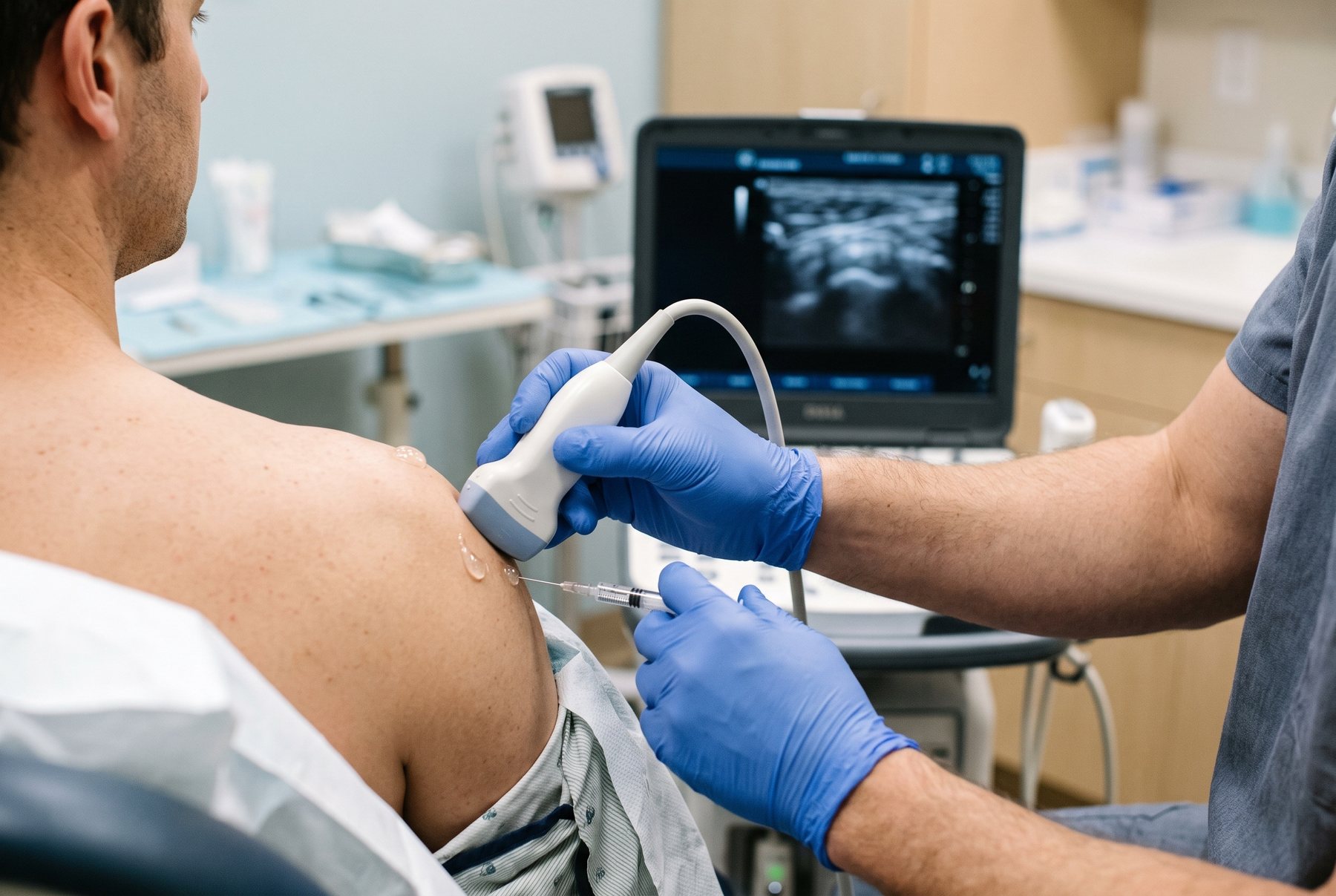
The concentrate is placed precisely — into the joint, the tendon or the lesion — usually under ultrasound guidance.
Rehabilitate
The injection is the start, not the treatment. A graded loading program over the following weeks is what turns a biologic signal into tissue that tolerates load.
This is probably not for everyone.
It tends to fit people who:
- You have osteoarthritis in a knee, hip, shoulder, thumb or spine and want to delay or avoid replacement surgery.
- You have a tendon problem — patellar, Achilles, plantar fascia, tennis or golfer's elbow — that has not settled with months of physical therapy.
- You have an acute sprain or ligament injury (MCL, LCL, ankle) and want to support the healing phase.
- You have been offered a cortisone injection and want to understand the alternatives.
- You are an athlete or active adult whose recovery window matters.
- You are curious about peptides and want a straight answer rather than a sales page.
If none of that is you, the measurement will tell us — and we will point you somewhere better.
Because these products come from your own body, allergic reaction risk is low, but injections carry the usual risks of bleeding, infection and a temporary flare of pain. Cell therapy is not standardized across clinics, and no product in this category is approved by the FDA to treat osteoarthritis — these are uses supported by clinical evidence, not by regulatory approval. We will tell you exactly what is being injected, from where, and what the evidence for it is.
What people ask us.
Is PRP covered by insurance?
Generally not — it is usually treated as a self-pay service. We will give you the full cost before anything is scheduled.
How many injections will I need?
Many knee osteoarthritis protocols use a series of three, spaced a few weeks apart. Some tendon problems respond to one. Your plan depends on the tissue and your response.
Are stem cells from my own body safe?
Autologous (your own) tissue avoids rejection and transmission risk. The real questions are whether the dose is adequate and whether the evidence supports the specific use — those are the questions we answer with you.
Do you offer peptides?
We will discuss them, including the limits of the evidence, and we will not sell you something we cannot justify. Some peptide uses are not something we will offer at all.
Other lines in the program.
Curious what Regenerative could do for you?
The answer starts with your numbers, not with the treatment. Book an evaluation.