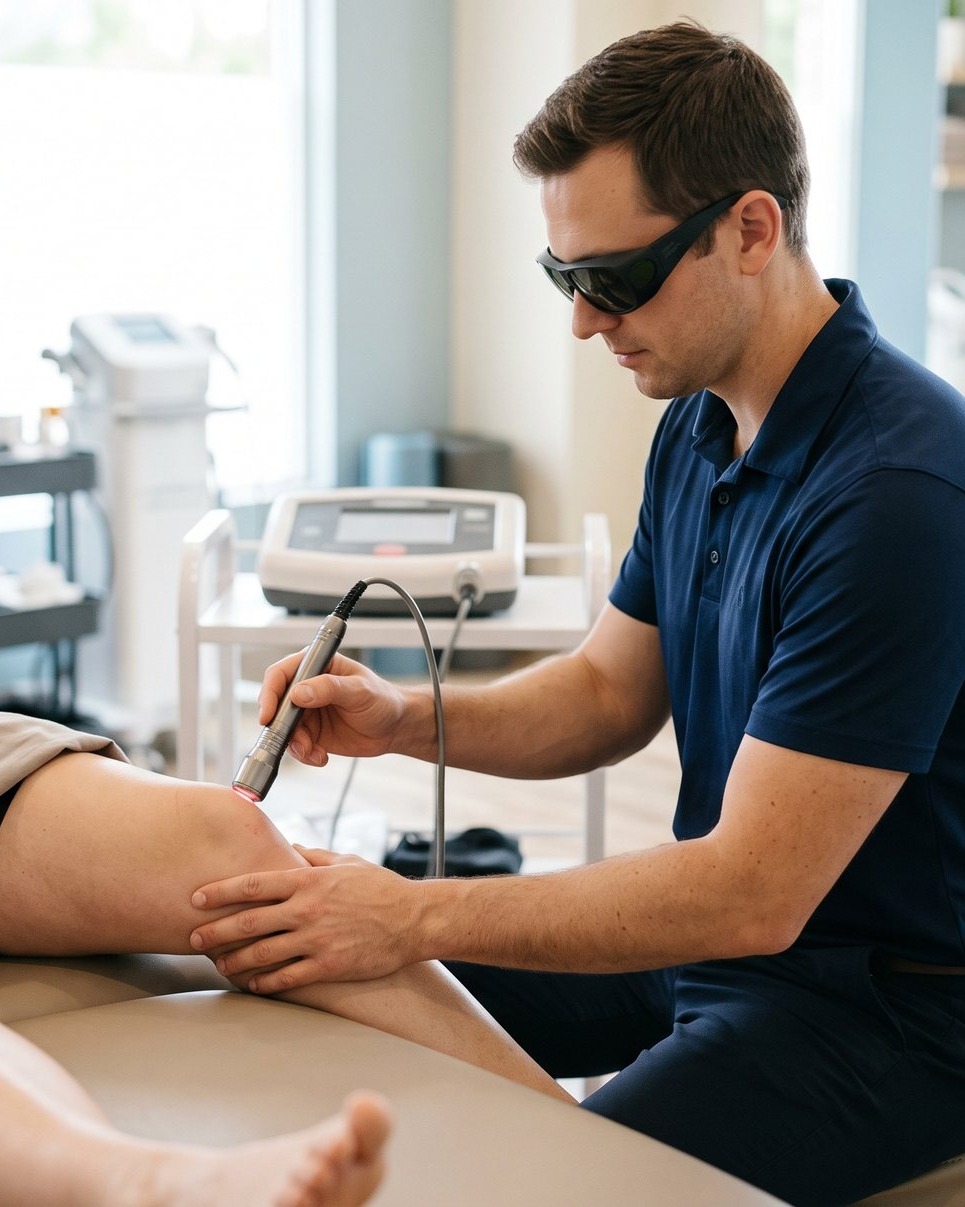
Light that reaches the tissue.
Photobiomodulation — the clinical name for therapeutic laser — uses specific wavelengths of red and near-infrared light to reach mitochondria inside your cells. The light is absorbed by a molecule called cytochrome c oxidase, which nudges cells to produce energy more efficiently, reduces oxidative stress, and calms the inflammatory signaling that keeps injured tissue painful and stuck. Class IV devices deliver therapeutic energy at a power and depth that surface devices cannot reach, which is what makes deep tissue treatable in a clinical timeframe.
Red light therapy at a spa is not the same treatment
Red light therapy commonly offered at spas uses low-power panels intended to treat the surface of the skin. It is not an equivalent treatment. A Class IV laser delivers 10 to 60 watts — enough energy to reach muscle, tendon, joint capsule and nerve at a therapeutic dose, in minutes rather than half an hour. Class IV lasers also require a physician or advanced practitioner to administer, which is precisely why the two should not be compared.
What it actually does to tissue
At the cellular level, laser light increases ATP production, improves local blood flow and lymphatic drainage, and shifts the balance of inflammatory mediators. Clinically that shows up as less pain, less swelling, and tissue that tolerates rehabilitation better. It is a companion to movement work, not a replacement for it.
Real benefit, in the applications we use it for
Many of the applications we use Class IV laser therapy for have been shown to produce real benefit: arthritic joint pain, chronic tendinopathy, post-surgical swelling and mobility, muscle injury and nerve-related pain. We offer fixed treatment packages and re-assess progress against your specific clinical scenario and your response to treatment. If you want the peer-reviewed detail behind any of it, our reference page at orthovida.com/evidence/laser.html is written for exactly that.
Shown to deliver real benefit.
These are the applications we use it for, and in each of them Class IV laser therapy has been shown to produce real benefit.
Arthritic joint pain
In randomized trials in knee osteoarthritis, laser therapy has produced real reductions in pain and measurable improvement in function — most reliably when combined with exercise.
Post-surgical swelling and mobility
Reduced post-surgical swelling and better early mobility, consistent with laser therapy's effect on local circulation and lymphatic flow.
Muscle and tendon injury
Eases pain from muscle and tendon injuries while supporting tissue repair, making it a useful companion to active rehabilitation.
Nerve-related pain
Trials report eased neuropathic pain and improved nerve conduction, with the effect building across a course rather than in a single session.
Every study behind these claims — the trials, the doses, the patients studied — is listed on our reference page, with each paper openable on PubMed.
What a treatment actually looks like.
Target
The clinician glides the laser head over the injured area — no needles, no downtime, typically minutes per session.
Stimulate
Deep-penetrating, comfortably warm light reaches muscle, tendon, joint and nerve where creams and ice cannot.
Recover
Session by session, treated tissue tends toward less pain and swelling — and moves more freely as rehabilitation continues.
This is probably not for everyone.
It tends to fit people who:
- You have joint pain that limits what you want to do, and you would rather not start with an injection or a daily pill.
- You are in rehabilitation after an injury or surgery and want to tolerate the work better.
- You have a tendon that has been grumpy for months.
- You want something that adds to physical therapy instead of replacing it.
If none of that is you, the measurement will tell us — and we will point you somewhere better.
Class IV therapy lasers are FDA-regulated medical devices, and in Ohio their use is reserved to physicians and certain advanced practitioners. Treatment is generally well tolerated; the most common effect is mild, temporary soreness or redness at the treatment site. Protective eyewear is worn by everyone in the room. Laser therapy is not used directly over the thyroid, over a pregnancy, or over known cancerous tissue.
What people ask us.
How is this different from red light therapy at a spa?
They are not equivalent treatments. Spa red light panels are low-power devices that treat the surface of the skin. Clinical Class IV lasers deliver far more energy, reach muscle, tendon and joint, and are administered by a physician or advanced practitioner. The difference is both the dose that arrives at the tissue and who is delivering it.
Does it hurt?
Most people describe a gentle warmth. You can stop at any point, and the clinician adjusts power to your comfort.
How many treatments?
Acute problems often respond in 4 to 8 sessions; chronic tendon and joint problems usually need a longer course. We reassess rather than selling a fixed package.
Other lines in the program.
Curious what Class IV Laser could do for you?
The answer starts with your numbers, not with the treatment. Book an evaluation.