Before we treat you,
we measure you.
Every patient begins the same way: the numbers inside your body first, then a short look at how you move. It takes one long visit, and it changes what the next ten years look like.
Two people. Same age.
Entirely different biology.
Chronological age is a date. Biological age is a state — and it is measurable. Two 52-year-olds can differ by a decade in inflammatory load, metabolic efficiency, hormonal status, muscle mass and movement quality. One is compounding health; one is spending it.
The problem is that medicine rarely looks until something breaks. A standard physical checks a handful of numbers once a year and clears you if nothing is flagged. But "not diseased" and "performing well" are different targets, and only one of them is what most people actually want.
The Method is our answer: measure broadly, read the pattern, treat precisely, then re-measure.

One panel. One complete picture.
The blood panel is the foundation — the numbers every other decision is read against. What you can physically do with those numbers is the second, smaller question.
The standard panel is built to find disease. Ours is built to find drift — the sub-clinical changes that precede disease by years. That means more markers, read as a pattern rather than as individual flags.
Four steps, repeated for as long as you are a patient.
Analyze your physiology
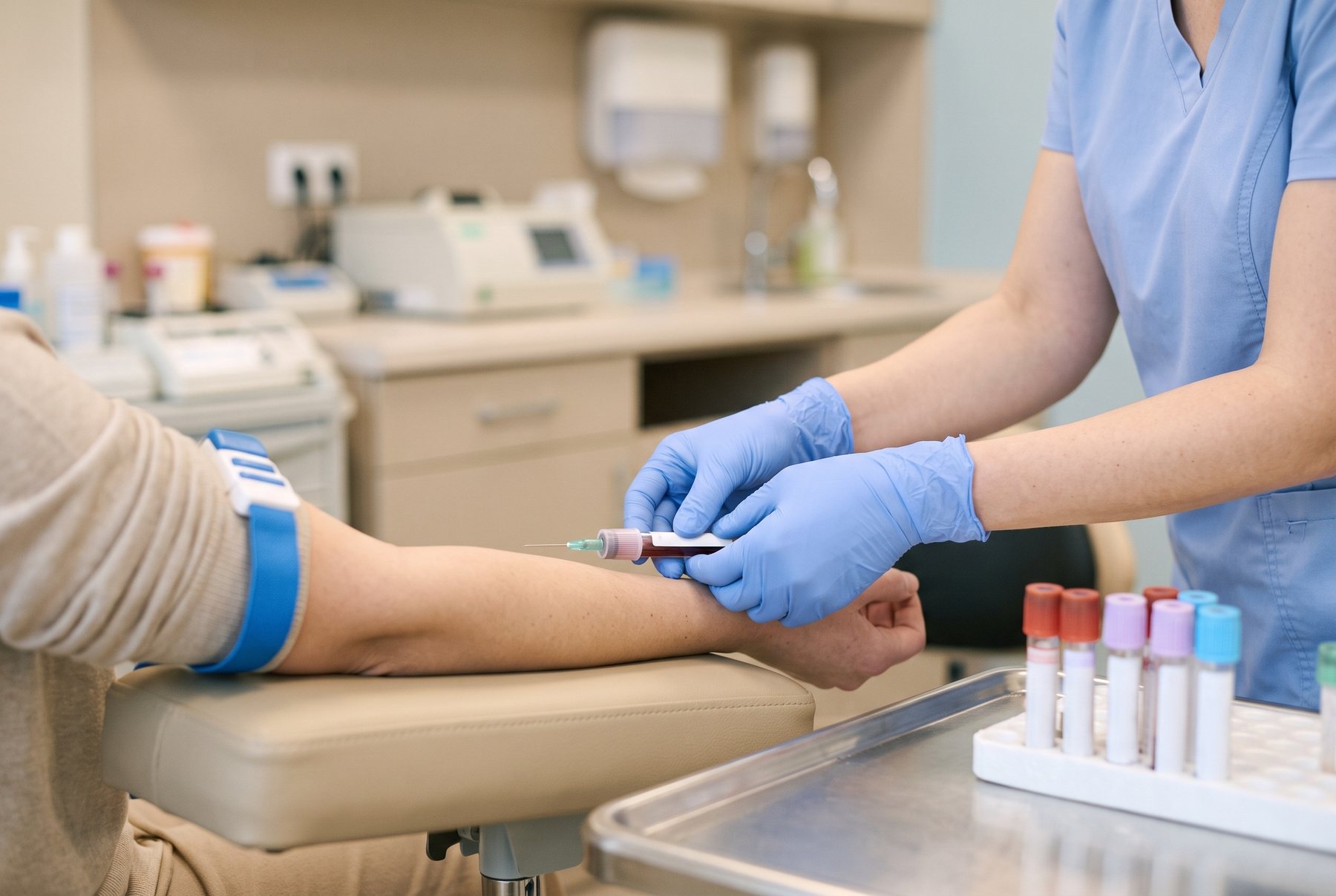
A single visit collects everything: blood, hormones, cortisol, microbiome, allergies, body composition and sleep — with a short, clinician-scored look at how you move. Nothing is guessed.
Personalize your plan
A clinician walks you through your own results, line by line, and builds a program around what is actually off — not around what is popular.
Optimize body & mind
Treatment, movement and recovery are matched to your findings, then adjusted as your numbers move.
Re-measure
Retesting is how you know it worked. The plan follows the data, and the data follows you.
How you move, and what it lets you keep doing.
Your blood and your hormones are the main event. How you move is the second question, and we ask it in plain terms: can you stand on one leg while you pull on a sock? Get up off the floor without using your hands? Carry the groceries up a flight of stairs, or play three sets of tennis, without your knee deciding the outcome — or catch yourself when you trip?
A clinician watches and scores a short series of ordinary movements and reads two things from them: stability, which is whether you can control a joint while it is under load, and mobility, which is whether it moves through the range the task needs. Where one is short is usually where a treatment either works or fails.
It stays secondary to your biomarkers, and deliberately so. The numbers say what is happening inside you; how you move says what that means for your week — the stairs, the garden, the court, the floor.

The results review
Two weeks after your baseline, you sit down with a clinician and your results — not a portal message, not a printout with arrows. You go through them line by line.
It is not a lab review. It is where data becomes a plan, in three parts: here is what we have learned about you, here is what we believe matters, and here is what we can do next. You leave with a written summary of what your numbers show, a plain-language explanation of what that might mean for how you feel, and a set of options — including the option of doing nothing yet.
Why retesting matters
Any clinic can produce a lab report. The test of a program is whether the numbers move, and whether you can feel the difference in the same place. We retest on a defined schedule and show your trend, not just your snapshot.
If a treatment is not working, we stop it. That is the entire point of measuring.
Start with the measurement, not the treatment.
Book an evaluation and we will call you to schedule your baseline visit.